





With AI, anything will be possible. It promises to enhance human abilities and make us smarter while gradually sparing us the trouble of thinking. Why not? Anything is possible with AI… There’s something rather funny about that.
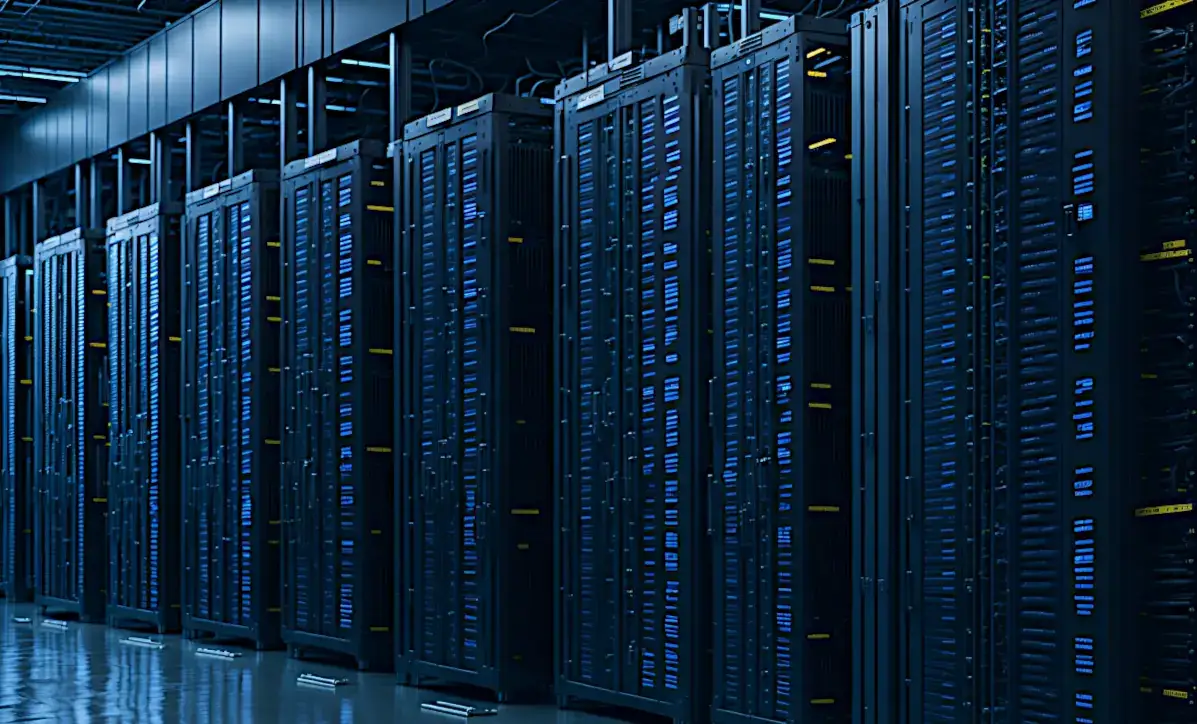
One small detail, though. It takes hardware to run this supposedly “immaterial” intelligence. Lots of hardware and unreasonable amounts of resources: metals, semiconductors, power stations, networks, buildings, water and enormous data centres.
So much so that students and other young people in the United States are already mobilising against the environmental impact of the enormous infrastructure needed to develop and run AI systems.
A very material kind of intelligence
I’ve already written about the verbal trick that makes us think digital technology is immaterial. AI doesn’t live in a “cloud” either. It belongs squarely to this “dematerialised” world that, paradoxically, has probably never depended so heavily on physical resources.
And that’s only part of it. AI is arriving in a world already suffering from chronic overexploitation of resources. We know where that leads!
The International Energy Agency expects global electricity consumption by data centres to nearly double by 2030. In France, ADEME estimates that electricity use associated with AI could nearly quadruple by 2035.
To justify this unchecked expansion, we’ll be told that servers are getting ever more efficient. We know how that tune goes! As soon as a technology becomes more efficient and cheaper, people use more of it. That’s the rebound effect. The digital world is already giving us a demonstration at full scale. Each computation uses less energy, but the system as a whole keeps using more.
And the argument that’s supposed to settle the debate? AI will optimise energy use… while guzzling energy to run the very systems tasked with optimising it. Absurd.
The machines also need cooling. Cooling accounts for around 30% of a modern data centre’s energy consumption. The growth of AI also puts pressure on local water supplies. And water is something humanity is increasingly running short of, on a chronic basis.
Mineral resources are already being exploited to excess: copper, nickel, aluminium, graphite, rare earth elements… The digital sector, particularly AI, competes with other sectors for the resources essential to the energy transition. Wind turbines, power grids, solar panels and electric cars also require enormous quantities of materials.
That makes the question political, economic and even philosophical. In a world with finite resources, what should we prioritise? A medical model that could improve a diagnosis? Probably. Generating pictures of cats dressed as superheroes? Frankly, that one deserves a second thought.
A more powerful system… and a more fragile one
Let’s be clear. Resilience is already an urgent question. The more essential functions we entrust to a handful of complex digital systems, the more our society depends on those systems working. That goes for energy, telecommunications, healthcare, banking, public services, transport, businesses and more.
AI can make these systems more efficient. That’s true. It also often makes them more complex and leaves them dangerously dependent on more things going right. Once infrastructure becomes indispensable, a failure becomes a real economic and social problem.
Even electricity could become a matter of competing priorities. Should we give priority to powering data centres or to electrifying transport, industry and heating? When the power grid is under strain, which uses should come first?
Technology leaves us with political choices to make. It often makes those choices a good deal harder.
Is AI going to nick our jobs?
It’s often one of the first worries people raise when AI comes up. Human history is full of inventions that have helped eliminate certain tasks, directly or indirectly. They often create new ones along the way.
AI is part of that long history, with a few differences. It reaches into intellectual work and is being rolled out at a dizzying pace, if not an outright reckless one.
It can already do a lot: translate, write code, draft text, illustrate, help with diagnoses, analyse, give advice… The list grows almost daily. I’m mainly talking about generative AI here, though there are many other kinds.
Let’s be honest. These innovations can eliminate some backbreaking tasks and improve productivity. Sometimes that’s a good thing. We’ve all seen those robots that spend all day washing supermarket floors. They never tire, complain or take the initiative. And let’s remember that they come with a hefty environmental footprint.
Whether you think getting rid of a job often seen as unrewarding is a good thing or not, one question remains. What happens to the person who used to do it? Move them to another part of the business? That isn’t always possible, especially in small companies. A universal basic income? The idea drew smirks a decade ago, but it’s back in the debate. If machines replace people, those people still need to make a living. Pair a basic income with a tax on machines and the idea starts to sound almost appealing. Unemployment? Often. It’s a miserable outcome for the person and a costly one for society.
Then there are the productivity gains themselves. What are they for? If one person with AI can do the work of three, we could let that person work fewer hours. Or we could sack the other two and ask the remaining person to produce four times as much. Strangely enough, the economic system has enough of a track record for us to guess which option it tends to favour.
I’m not sure this “great replacement” by machines will happen as quickly as we fear. There are plenty of constraints: water and energy use, employers’ liability when something goes wrong, the risk of hacking and dependence on countries that aren’t particularly friendly to us. Then again, it could happen faster than we think. It all depends on the choices societies make. That’s one reason to keep an eye on the US student movement.
And now, AI-enhanced warfare
AI will do more than write meeting notes or clean office floors. I’m still unconvinced that machines will replace workers on a vast scale, but AI is already finding its way into cybersecurity, intelligence, drones and military systems. That brings risks involving weapons and security.
The most worrying scenario isn’t necessarily some mysterious AI becoming self-aware and deciding to wipe out humanity. Frankly, just look at the disasters of bygone eras, some of them rather less bygone than we’d like. Humans are perfectly capable of managing that on their own.
In my view, the real danger lies in putting systems in human hands that can identify, monitor, target or attack far more quickly.
Artificial intelligence will never put an end to human stupidity. It can give it a serious boost in computing power and make our actions even more devastating.
What if AI really does end up making us all complete idiots?
This may be the risk that scares me most. With generative AI in particular, we’re teaching younger people, and older ones supposedly wise enough to know better, that learning is just a matter of getting an answer. Learning means trying to work things out, failing, starting over and understanding.
Getting solutions instantly risks depriving us of the trial and error, mistakes and difficulties that help us develop our intelligence in the first place. It’s a dizzying thought.
The more I look around, the more I think the process is already well under way. When common sense seems to be disappearing as fast as AI is advancing, there’s reason to worry.
The machine spares us the mental effort that builds our ability to think.
Here’s what I was taught as a student:
- Writing helps organise your thoughts.
- Doing calculations teaches you to reason.
- Trying to work things out develops your intuition.
- Making an argument forces you to weigh competing ideas.
- Memorising gives you knowledge you can draw on when you think.
So what happens if we outsource all that and leave AI to do the very tasks that help our brains develop? Imagine what that could mean for children!
Mental health and social life under threat
Intelligence is more than the ability to produce answers. It develops through interaction with other people.
I know this is going to sound terribly idealistic. To develop as human beings, we need real contact with other people. Talking, disagreeing, explaining, waiting, listening…
All those experiences risk becoming poorer when digital interfaces take the place of human relationships. In a world that pushes everyone to produce more and move ever faster, they’re slow activities. They take time.
A machine available around the clock and always ready to agree with us can sound appealing. But do we really want a society without direct contact or disagreement? Is a future in which billions of people are alone with their technology something to look forward to?
We can already see the damage done by social media bubbles. People convince themselves they’re right because everyone they spend time with thinks like them and agrees with what they say. The reasoning goes in circles. If everyone else thinks like me, I must be right. All without much critical thinking, any fact-checking or sometimes even a moment’s thought.
And what about the rolling news channels that rot people’s brains by showing three idiots beating each other up on a loop? Viewers conclude that France is at war in its streets. If the three are cops, then the police must be violent everywhere.
Add generative AI and there you have it. People end up captive to their prompts, or in love with them. They struggle to think for themselves, pass along any stupid story or image, and end up a nervous wreck at the prospect of stepping into the real world or unable to handle the slightest disagreement.
Some leaders’ dream: docile, isolated people who depend on technology. My idea of hell. I stay off social media and steer clear of most AI tools whenever I can…
Making choices before imposing bans
AI can be extraordinarily useful. I’m hardly calling for a boycott. For me, it’s mostly useful for translating or proofreading a text. In medicine, scientific research and many other fields, plenty of applications deserve our attention. Throwing it all out would be absurd.
For now, though, our leaders and businesses, both in the AI industry and beyond, are approaching the issue backwards. For economic reasons, of course.
Before rolling out AI systems on such a massive scale, especially to the general public, we should ask whether we can afford to do it and whether we should. Is AI actually useful in the first place? Does churning out bland, stupid pictures for a laugh with your mates justify taking up water supplies that are already under pressure?
And if AI solves a few problems, how many new ones does it create in return? Who actually benefits from its rollout? Does it make us more independent or more dependent? And what happens if we have to cut back on using it?
Then there are the questions about what it does to our brains and our mental health. Is it gradually sparing us the need to learn, understand or do things for ourselves? And in the end, does it make us happier?
However powerful AI becomes, it will count as real progress for humanity only if it improves our lives without harming the living world. Having machines that can answer all our questions while we gradually lose the ability to think for ourselves would be a strange way to enter the age of intelligence… artificial or otherwise!